Sculpture RFQ Checklist: Get a Comparable Project Quote
A rendering can communicate a sculpture’s mood while leaving almost everything that controls its quotation undecided. A designer may see a finished lobby centerpiece; a fabricator may see an unresolved shell, support, finish and installation interface. This checklist turns that gap into a brief a buyer can issue, revise and compare.

Start with the decision you need
Write the purpose at the top: an early feasibility discussion, a budget allowance or a quotation against an agreed design. These are different requests. If your client has not selected a material or final size, say so. Ask for assumptions and alternatives rather than a price that appears precise but silently depends on someone else’s choices.
An RFQ works best when several suppliers price the same defined deliverable. If you still need competing design concepts, describe the design service separately, including the outputs you want to review. Do not compare a proposal that includes design development with one limited to making an already approved model.
Give the brief an owner, an issue date and a version such as Lobby artwork RFQ v02. Keep the reference files in a numbered list. When a supplier asks a question that changes the scope, send the answer to every participant and record whether it changes the brief. This simple document control often matters more than adding another inspiration image.
The sculpture RFQ input checklist
Use three status labels: confirmed, provisional and unknown. An unknown is useful information when it has an owner and a decision date. It becomes a problem when it is presented as an approved requirement. The table separates information sufficient to start a conversation from evidence normally needed later to release relevant work.
| Input | Send with the RFQ | Resolve before relevant work |
|---|---|---|
| Purpose and quantity | Project type; quantity by design, size and color | Approved variant list and any first-off sample requirement |
| Authorized references | Numbered images, sketches or available model files | Approved model/drawing revision and permission to reproduce |
| Dimensions | Height, width, depth; units; base included or excluded | Agreed envelope, critical dimensions and tolerances |
| Material and construction | Preferred material or performance/appearance priorities | Project-specific construction and support scope |
| Surface finish | Color, gloss, texture references and viewing distance | Physical sample and agreed approval conditions |
| Use environment | Indoor/outdoor; public contact; cleaning and exposure | Site-specific requirements reviewed by responsible parties |
| Site and access | Location, photos, route and known access limits | Coordinated installation interface and handling plan |
| Delivery boundary | Destination and named handoff point | Packing, freight, unloading and installation responsibilities |
| Schedule | Required site date; opening date; approval availability | Dated milestones with dependencies and owners |
| Acceptance and records | Requested inspection and handover information | Acceptance criteria, inspection method and release authority |
| Commercial boundaries | Budget scope if disclosed; requested currency | Written inclusions, exclusions, validity and change procedure |
| Decision owners | Design, procurement and site contacts | Named approvers for model, finish, inspection and site work |
These rows are a procurement framework, not a universal engineering specification. Some projects require specialist information beyond this list. For example, a suspended piece introduces a support interface that a freestanding decorative object does not share. Identify that interface early rather than adding assumed fixing details to a generic RFQ.
Make drawings, images and finish references unambiguous
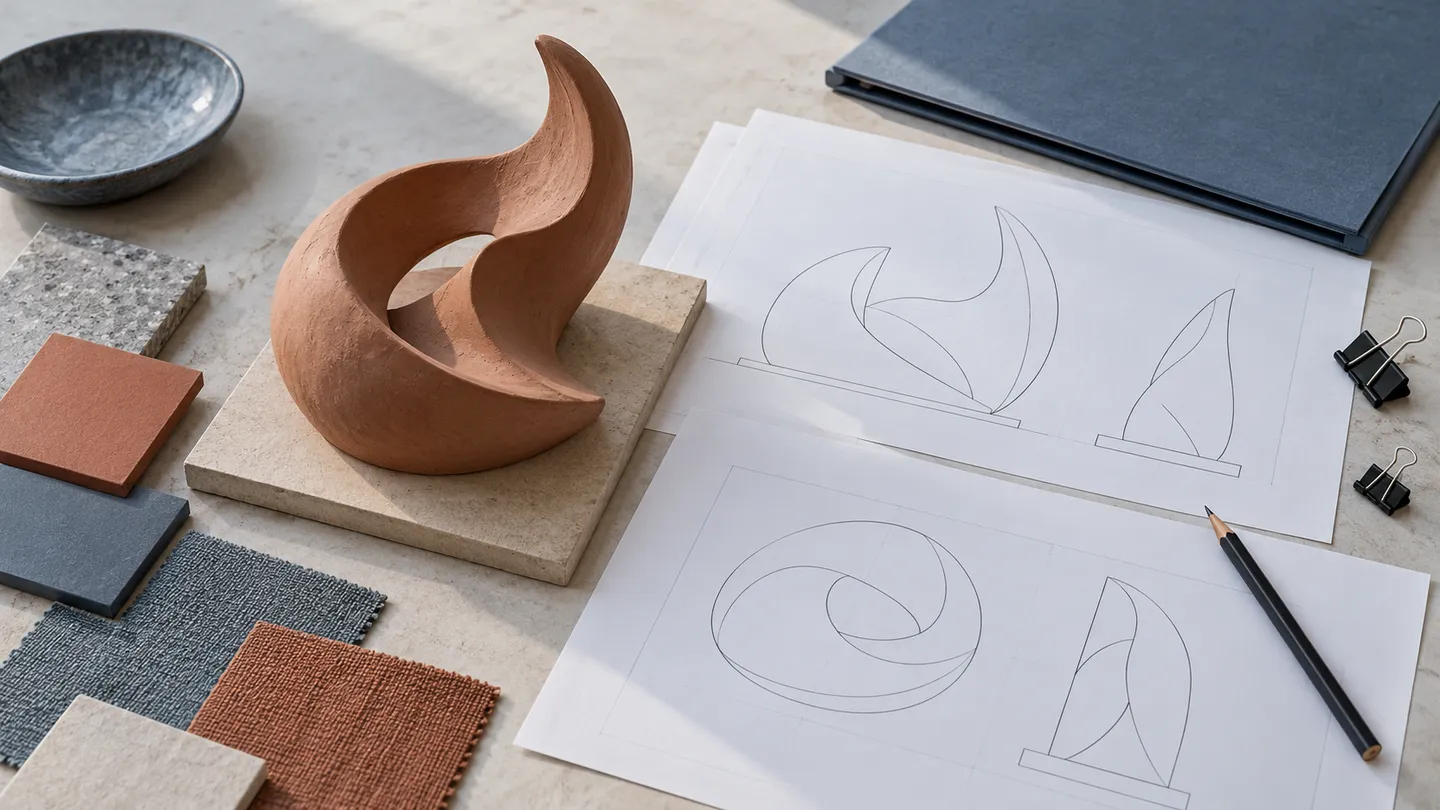
Separate the image that controls the silhouette from the image that illustrates the color or surface. If you send three different sculptures as references, write what you want from each one. “Form from image 01, brushed appearance from image 02, no copying of image 03” gives a supplier a much clearer task than an unlabeled mood board. Confirm that you have permission for any design you ask someone to reproduce.
Where possible, include views that expose the back, underside, thin extensions and connections. American Fine Arts Foundry’s pricing form also asks for multiple reference views as part of an accurate quote request. Our practical addition is to label the controlling view and identify unresolved surfaces, so an attractive front rendering does not silently authorize an invented rear elevation.
For dimensions, state units every time. Distinguish artwork-only height from overall height on a pedestal, and record the full width and depth. The widest installed point may be different from the narrowest shipping section. A file name is not a reliable dimension: put the envelope in the written brief and ask the supplier to confirm what was priced.

Describe a metallic finish in observable terms: brushed or mirror-like, directional or uniform, acceptable visible seams, and typical viewing distance. Screens and renderings do not establish an approved physical color. Request a sample where appearance is important, and agree who will view it, under which lighting, and how the accepted sample will be identified and retained. Ask what a proposed alternative would change before treating it as equivalent.

Describe how people and the site will interact with the sculpture
“For a hotel” is not enough. Is the piece behind a reception desk, beside a circulation route, outdoors near irrigation, or within reach of visitors? Will staff move it? Does cleaning require access behind it? Describe intended contact rather than letting the supplier infer it from a decorative rendering. Send site photos with the proposed position marked and distinguish actual measurements from estimates.
A current example helps explain why this belongs in the brief. Dix Park Conservancy’s October 2026 description of Alexandre Arrechea’s Orange Functional identifies it as a playable public artwork. The procurement lesson is our own: intended participation is a design input, not an optional label added after fabrication.
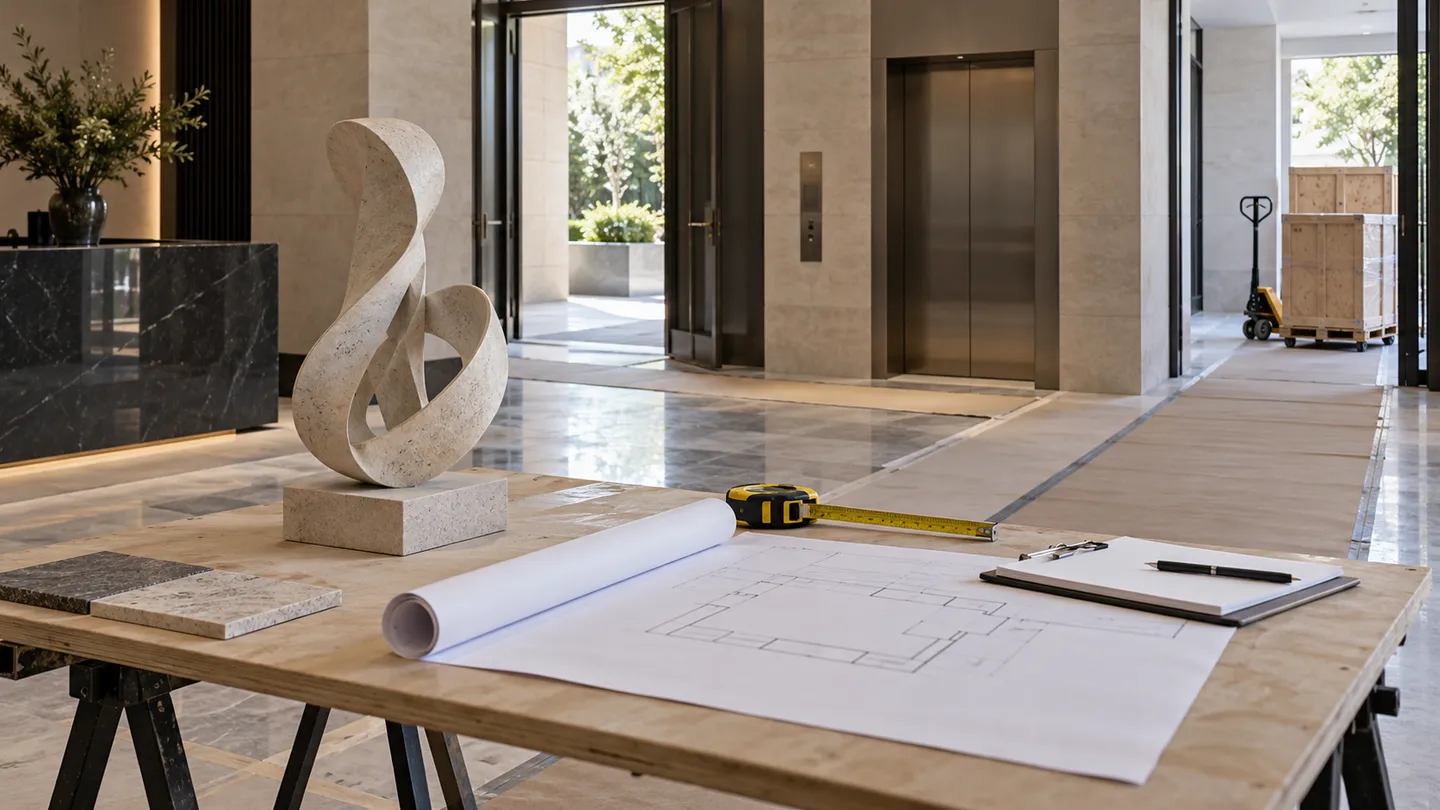
Map the complete route from the delivery handoff to the final location: unloading area, doors, turns, lifts, floor changes and temporary storage. Ask your site team to verify constraints; do not scale a doorway from a photo. If an assembled piece cannot pass, the brief should ask for a proposed sectional approach and visible-joint implications. It should not prescribe an unreviewed structural solution.
Define the requested delivery endpoint in plain language as well as any agreed trade term: for example, the named warehouse rather than “shipping included.” Then identify who arranges local transport, lifting, assembly, anchoring, touch-up and removal of packing. The Public Art South West commissioning guidance is useful context for viewing a commission as a wider project with several responsibilities, rather than only a fabrication purchase.
Set approval gates without pretending the RFQ is a design approval
Assign one person to consolidate design comments. Several people can review a model, but contradictory instructions need resolution before a revision is authorized. Name separate owners for commercial acceptance and site coordination: the person selecting a color may not have authority to approve additional scope or a fixing interface.
For every approval, record the item, revision, approver, date and remaining conditions. “Approved with comments” needs a closed comment list; it should not be interpreted as permission to resolve important issues silently. If engineering or electrical review is needed, appoint the responsible professional and identify when that approval must be available.
Ask suppliers to separate their production milestones from the time your team needs for reviews. An arrival deadline depends on more than fabrication duration. A late sample approval or an unresolved access route can change the plan even when the workshop is ready. Request an updated schedule after a material change instead of carrying the old dates into a revised order.
Before issuing an order, use the companion sculpture quotation comparison worksheet. It turns this common brief into a consistent comparison of scope, allowances and unknowns. The brief establishes what everyone was asked to price; the worksheet checks what each response actually covers.
A worked starting brief you can adapt
Illustrative scenario, not a completed Weiya commission: a design team needs one abstract metal piece for an indoor lobby. The appearance is brushed silver, the approximate artwork envelope is 1.8 m high × 1.2 m wide × 0.6 m deep, and the base is undecided. Visitors may touch the lower area. The opening date is fixed, but the delivery route has not been measured.
A useful RFQ does not hide those gaps. It asks for a budget estimate against the stated envelope, a separate base/interface proposal for review, a finish sample, and a list of information needed before a firm production release. The designer owns form and finish comments; the site representative owns measured access and local review; procurement owns scope confirmation and order authorization. The supplier lists its assumptions rather than filling in unknown site conditions.
Download the editable sculpture RFQ template (.txt). Replace the example fields, attach authorized references and keep the version number on every issue. If a supplier proposes a useful change, add it as an explicit option rather than overwriting the baseline for only one participant.
For the wider process, read our custom sculpture commissioning guide. This worksheet focuses on the procurement decision within that process.
Bring the project into a scoped conversation
Explore Weiya’s metal sculpture references, then send your references, dimensions and site information. Tell us which decisions are still open. We can discuss the inquiry against the material families in our catalogue; price, suitability and schedule depend on the agreed project scope.
Before authorizing the next stage, use the sculpture drawing approval checklist and review log and the finish sample checklist for project lighting to record the decisions and references your team still needs.
Frequently asked questions
Can I request a sculpture quote without a 3D model?
Yes. Send authorized reference images, approximate height, width and depth, quantity, intended use, destination and required site date. Ask the supplier to list assumptions and any separate modeling work. A preliminary estimate is not the same as an approved production scope.
Should the base be included in the sculpture dimensions?
Show both the artwork envelope and the overall installed envelope including any pedestal. Mark the base and fixing interface separately so the fabricator and site team do not quote different boundaries.
How many reference views should I send?
Provide enough authorized views to explain the shape and important details, ideally including front, rear, side and top where relevant. Label unknown or undecided areas instead of asking a fabricator to guess from one image.
Do I need to choose the material before sending an RFQ?
No. State the desired appearance, use environment, contact expectations and maintenance access, then request clearly separated material options. Each option should identify its own construction, finish, approvals and exclusions.
Does a completed RFQ replace engineering approval?
No. An RFQ describes information and responsibilities for pricing. Project-specific structural, fixing, electrical or site approvals must be arranged with the appointed qualified professionals before the relevant production or installation work.
What should I do if a requirement changes after the quote?
Issue a revised brief with a new version and a short change log. Ask each supplier to confirm the effect on scope, price, approval work and schedule before treating the previous quotation as current.
Sources and further reading
Sources checked on 19 October 2026. These references support the limited observations identified above; our templates and worked examples are original editorial tools. Referencing another organization does not imply a partnership or endorsement.