Garden & Landscape Sculpture: A Designer's Guide to Choosing, Siting & Commissioning a Focal Point
The right sculpture is the most powerful focal point a landscape can have — it terminates a sightline, gives a flat lawn scale, and turns a pleasant garden into a memorable one. This guide is written for landscape architects, developers and estate, resort and hospitality clients: how to choose a style and material for the setting, where to place a piece, how to size it to the space, and how to commission and ship a custom work to your site program.
Why a Sculpture Is the Most Powerful Focal Point
A single well-placed piece does more than scattered ornaments. It gives the eye a destination, controls circulation by drawing people through a space, sets human scale against architecture and planting, and creates a genuine sense of place. For developers and operators that is not decoration — placemaking lifts desirability, dwell time and asset identity, and public art is increasingly treated as an asset within development projects. The landscape itself becomes the medium, in the tradition of land art.
Where to Place a Garden Sculpture
| Location | Effect | Tip |
|---|---|---|
| End of an axis / path | The classic destination | Centre it on the sightline |
| Path corner / curve | A “reveal” moment | Place just past the turn |
| Beside water | Reflection + sound = instant focus | Mirror metal doubles the light |
| Against a dark hedge / wall | Contrast makes it read | Avoid busy borders that compete |
| Framed in an arch / gap | A composed, intentional view | Centre within the frame |
| On the lawn | Risk: looks lost | Use rule of thirds, not dead-centre; add a plinth |
A plinth raises a piece to eye level and anchors a narrow form on open ground (a mid 40–70 cm base reads human and warm; 80 cm+ feels formal and processional). For first read, allow a viewing distance of roughly twice the sculpture's height. Night lighting transforms a piece — warm uplight for stone and bronze, downlight/“moonlighting” for polished metal; for wiring, mounting, foundations and wind-load engineering see our large outdoor sculpture engineering guide.
Choosing a Style for Your Landscape
| Style | Best landscape / setting |
|---|---|
| Classical figurative | Formal estate gardens, memorials |
| Modern abstract | Contemporary architecture, plazas |
| Animal / wildlife | Naturalistic planting, parks, family resorts |
| Geometric / minimal | Modern courtyards, arrival courts |
| Kinetic (wind-moving) | Open lawns, breezy sites, plazas |
| Mirror / reflective | Waterside, resort arrivals, modern settings |
Matching Material to Your Landscape — Not Just Durability
| Material | Effect in the landscape | Outdoor life | Best setting | Cost |
|---|---|---|---|---|
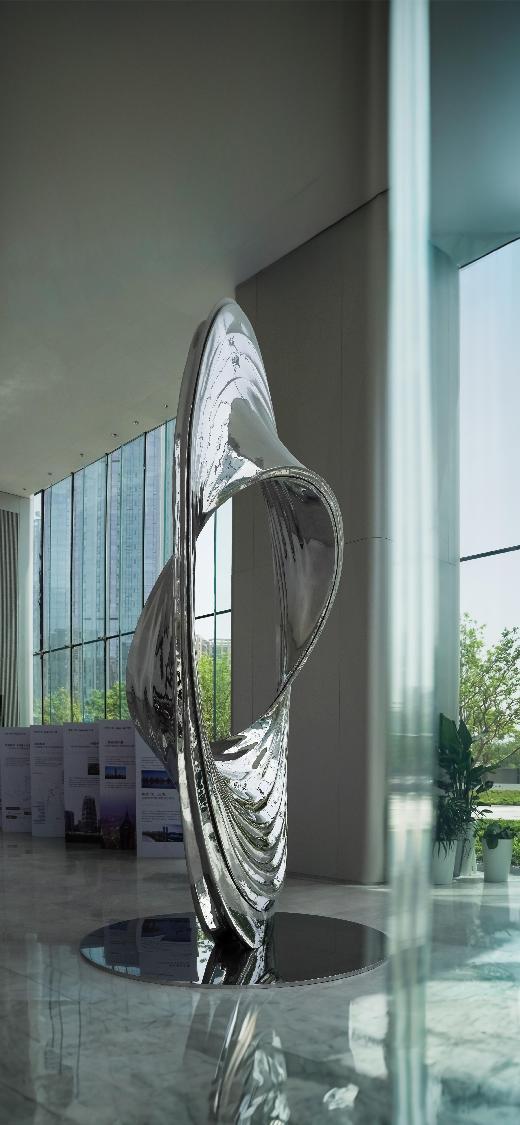
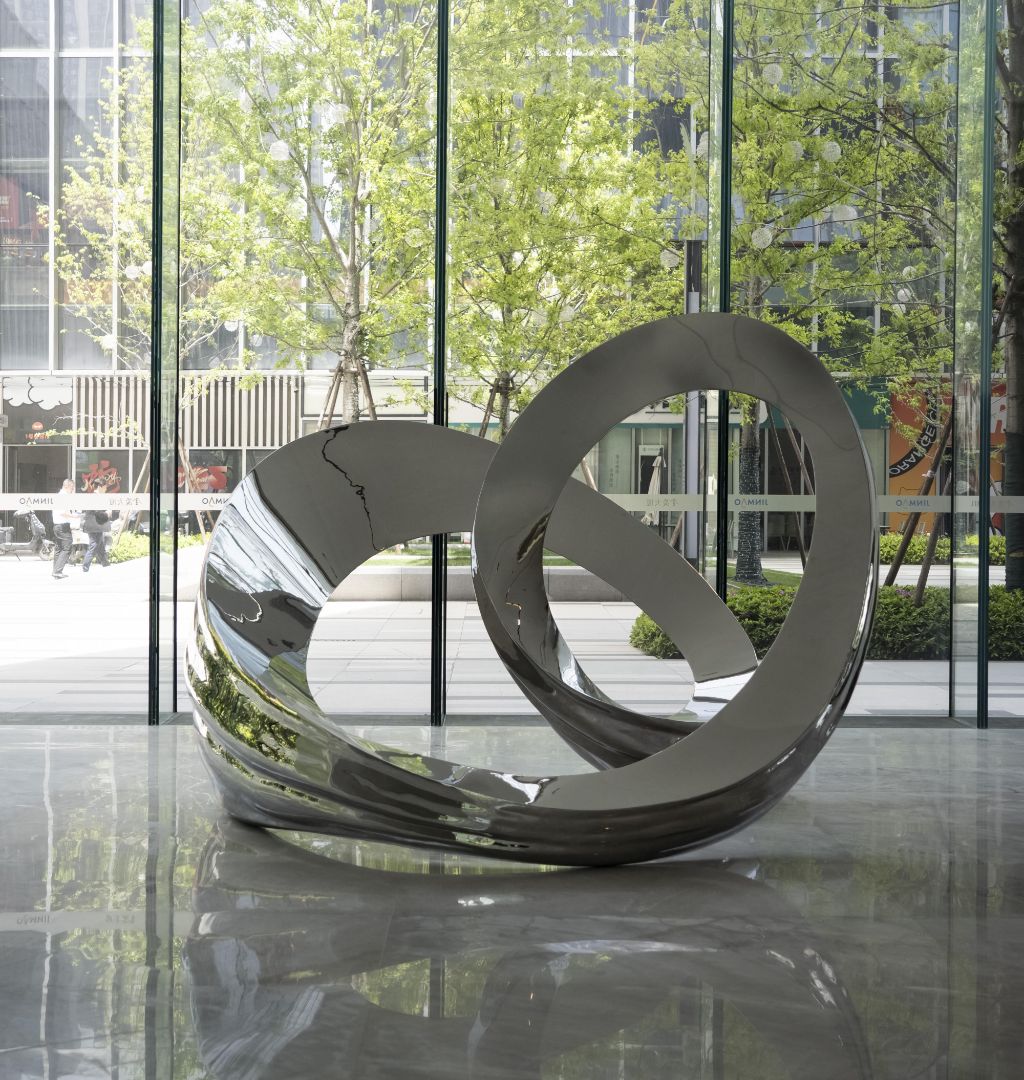
| Mirror stainless steel | Reflects sky, water & seasons; rust-proof | 50–100 yrs | Modern, waterside, resort | $$$ |
| Bronze | Warm self-protecting patina; blends with greenery | Centuries | Classical, figurative, animal | $$$$ |
| Corten / weathering steel | Russet rust that changes with rain & light | Decades | Naturalistic / wild planting, parks | $$ |
| Stone / marble / granite | Timeless, formal, tactile | Centuries (granite) | Classical estates, memorials | $$$ |
| Fiberglass (FRP) | Any color, large scale, lightweight | 10–20 yrs | Hospitality, themed, budget/large | $ |
Mirror steel animates a modern garden by reflecting its surroundings; Corten weathers into naturalistic planting; bronze and stone bring classical permanence; FRP delivers scale, color and economy where weight or budget matters. The choice is as much about the effect you want in the setting as about durability.
Getting the Scale Right: Sculpture Size vs. Space
| Space | Viewing distance | Suggested height |
|---|---|---|
| Courtyard / patio | 2–4 m | 0.6–1.2 m (often plinthed) |
| Small garden | 4–8 m | 1–1.8 m |
| Medium garden | 8–15 m | 1.8–3 m |
| Large / estate / resort | 15 m+ | 3 m+ statement piece |
Two rules keep proportion right: a piece reads best at about one-third the height of what's behind it (tree line or wall), and a narrow form on a wide lawn looks lost — raise it on a plinth, set it by water, or group in odd numbers (3–5). Design for winter too: a piece half-hidden by summer foliage can look exposed against bare stems and low sun.
Durability & Maintenance at a Glance
Stainless: an occasional rinse and polish. Bronze: the patina is the protection; optional wax. Corten: the rust self-stabilizes — no coating. FRP: gel-coat and UV care. Stone: periodic cleaning and sealing. For foundations, anchoring and wind-load on large pieces, see the engineering guide. Contemporary style references are well covered by design media such as Dezeen, and landscape architecture as a discipline is defined by the ASLA.
Commissioning a Custom Sculpture: Process & Global Shipping
We work to your landscape drawings and project program: brief and concept → 3D model and a material/finish sample → engineering and approval → fabrication and QC → export crating and sea freight → on-site assembly coordinated with your landscape contractor (foundation cast before delivery, craneage, sequencing with hardscape and planting). Tell us your design intent, site and timeline, and we slot into it.
Frequently Asked Questions
How big should a garden sculpture be for my space?
Which material is best for an outdoor sculpture?
Where is the best place to put a focal-point sculpture?
Can you work from my landscape design or drawings?
How do I maintain it, and will it rust or fade?
Do you ship worldwide and help with on-site installation?
Commission a focal-point sculpture for your landscape
Send your design intent, site and material preference — we reply with a concept, a sample option and a quote.
Request a Concept & Quote