Sculpture Handover Documents: Finish Records, Care Instructions and Spares to Request
Request a versioned sculpture handover pack before ordering: artwork and component identification, accepted finish references, dated condition photographs, agreed care instructions, installation records within the contracted scope, and an itemized spares schedule. Assign an owner and acceptance status to every document. Receiving a crate, receiving documents and accepting the artwork are separate decisions; unresolved items need a named action rather than an assumed sign-off.

Specify the handover deliverable while comparing quotations
A hotel purchaser can receive an attractive sculpture yet leave the facilities team without enough information to care for it. The missing item is often not a certificate: it is a usable explanation of which surface was accepted, which component belongs where, and who should answer a later question. A sculpture handover documents checklist belongs in the RFQ, where bidders can include, exclude or clarify each deliverable. Adding it after dispatch makes quotations harder to compare and leaves document ownership uncertain.
Use this guide for custom decorative metal artwork in hospitality interiors, reception areas, retail spaces and similar managed properties. Start with the decorative metal sculpture collection to identify an appearance reference, then attach the proposed handover schedule to the project inquiry. Despite the URL name, this collection is decorative artwork, not a standard industrial fastener catalogue. It does not establish material grade, spare-part interchangeability or structural performance. Those decisions require the actual project proposal and approved records.
Keep a separate list of documents the buyer will produce, such as the location schedule and facilities contact, and documents requested from suppliers or installers. Mark any unavailable document as pending, excluded or not applicable with a reason. An empty cell is not evidence that another party accepted the task.

Give every artwork, component and file a stable identity
Create an asset identifier before collecting photographs. A practical buyer-defined convention might combine a project code, location and artwork number; label it as your own convention rather than a manufacturer serial number. Record the catalogue reference separately, because a commissioned version may differ from its starting reference. If two similar sculptures go to different floors, they need distinguishable records even when their appearance is identical.
For an assembly, link the whole artwork to a component schedule. Describe visible position, orientation and matching drawing reference without guessing concealed fixings or materials. A separate label on a removable decorative part should point to the same component identifier in the packing and spares lists. Ask how labels can be used without marking sensitive surfaces; do not apply adhesive directly to an artwork without approval.
Keep the approved drawing revision, finish reference and file date in the document index. One controlled folder with an index is more useful than several chat attachments named final. Preserve superseded files in an archive and mark them clearly. The purchaser should be able to identify the governing version without interpreting a conversation history or relying on the employee who happened to receive the shipment.
Separate an appearance reference from an accepted finish record
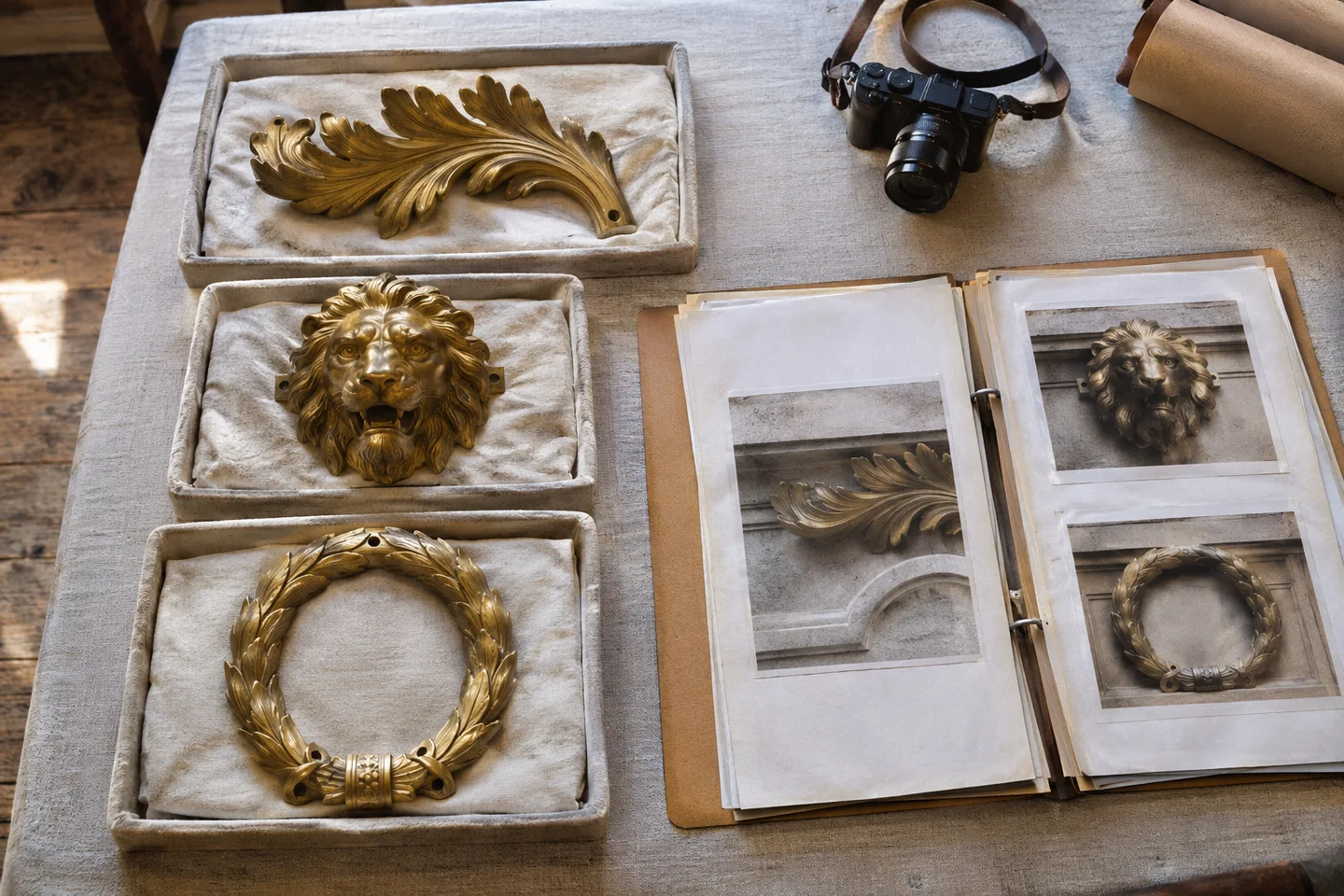
A catalogue photograph helps select a direction. An accepted finish record identifies what the parties actually reviewed for this order. Ask for the sample identifier, approval date, reviewer, agreed viewing conditions and any accepted variation. Record the relevant substrate and surface description only when confirmed; a gold appearance does not by itself establish plating, alloy composition or coating type.
For a sample review, capture an overall view and useful close details under recorded light. Note whether the image shows the physical approved sample, the production artwork or a concept. Screens and camera processing can change perceived color and gloss, so images should supplement the agreed physical or other contractual reference rather than quietly replace it. Preserve a retained sample where that arrangement is agreed, and identify who stores it.
| Reference type | What it supports | What remains to confirm |
|---|---|---|
| Catalogue or concept image | Initial shape and appearance discussion | Actual material, finish process and acceptance reference |
| Identified approved sample | Order-specific surface comparison | Applicability to the full form, seams and viewing conditions |
| Dated artwork photographs | Visible condition at a recorded stage | Hidden areas, technical suitability and unresolved observations |
The comparison diagram summarizes these roles. For the earlier approval stage, use the finish sample and project lighting review guide so the final pack inherits an identifiable decision rather than a vague note that the color was fine.
Build a dated condition baseline that the next team can repeat
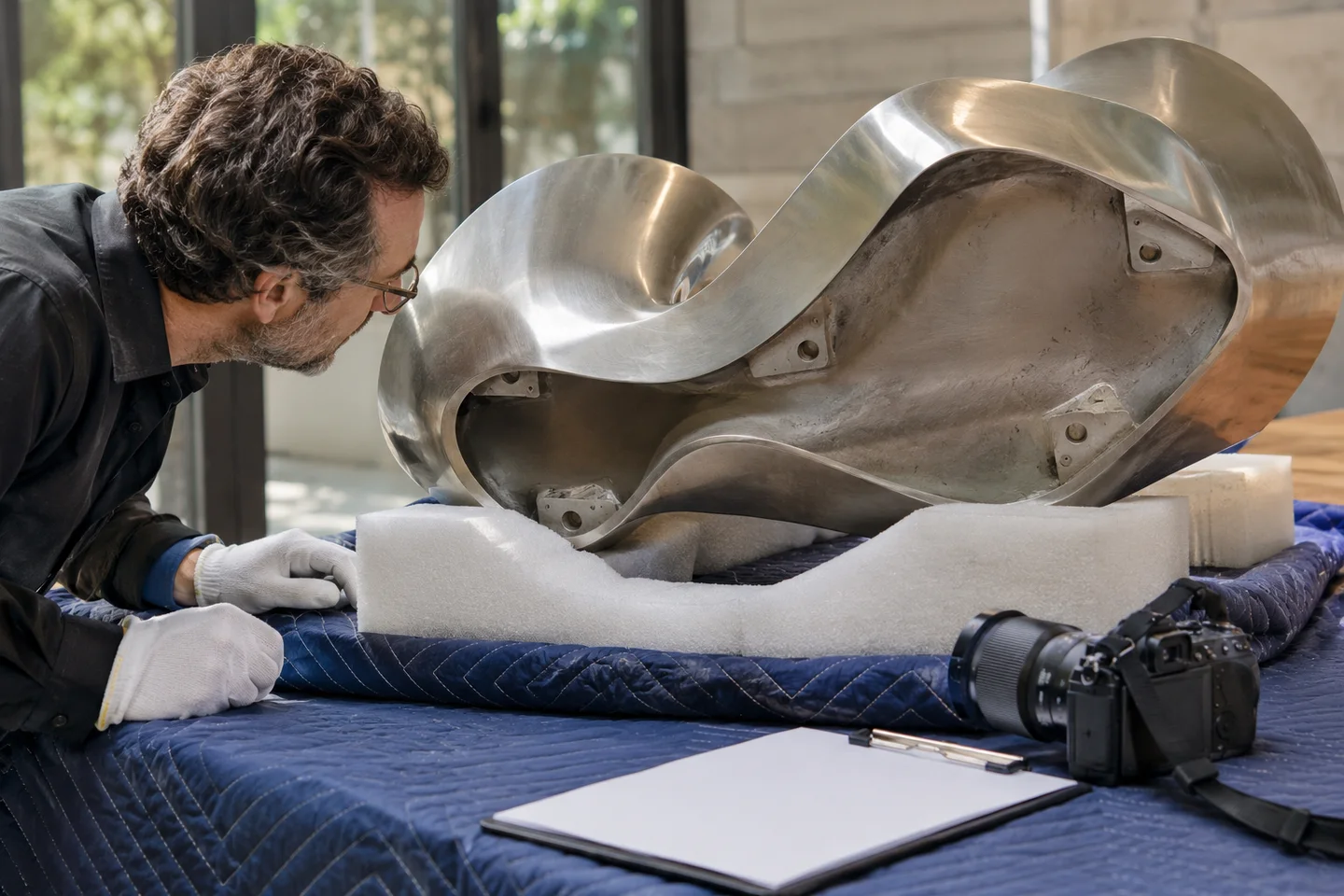
Photographs become useful records when a future observer can repeat the view. Choose an overall orientation, named sides and selected details. Include vulnerable projecting elements, edges, accessible joints, the base relationship and any agreed appearance exceptions. Identify views that could not be captured safely; do not move or dismantle artwork merely to complete a photo grid.
Pair each image with a short observation, date, location and observer. Separate an observed mark from an interpretation of its cause. Write, for example, that a pale line is visible on the left-facing edge in image A03, rather than declaring a coating failure without examination. Preserve original files and associate annotated copies with their originals. The Getty condition and examination framework distinguishes dated assessments from subsequent treatments, a useful separation for a procurement archive.
Set a baseline at the agreed transfer point and record later installation or relocation checks separately. If delivery and final placement happen on different days, retain both records. A post-installation image cannot establish everything that happened before unpacking. Link the pack to the delivery and assembly responsibility guide to identify who records each transition.
Request care instructions for the actual surface and setting
Ask for a care document that identifies its artwork and finish revision, intended environment, permitted routine actions, prohibited products or methods, and escalation contact. It should explain what facilities staff may do, what needs specialist advice and what requires a fresh authorization. Do not adopt a generic metal-polishing instruction for a patinated, painted or otherwise treated surface merely because the underlying object is metal.
Include access constraints: which faces can be reached safely, whether adjacent materials need protection, and who controls temporary public exclusion during work. Request inspection triggers linked to the setting, such as a move, accidental contact, water exposure or an observed surface change. Any inspection interval or cleaning product should be confirmed for the actual project; this guide does not supply a universal maintenance frequency or chemical recipe.
The Canadian Conservation Institute's outdoor-object guidance treats preservation planning as part of commissioning and ongoing care. Its collection context is not a specification for every commercial interior. The procurement lesson is to budget and assign care before handover, then obtain instructions appropriate to the confirmed surface, exposure and owner resources.
Define spares by part and purpose, not by an assumed allowance
Start a spares discussion by asking what is replaceable without changing the artwork's approved appearance or assembly. Separate cosmetic pieces, removable covers and consumables from load-bearing or safety-related components. A visually similar screw or bracket is not automatically an acceptable substitute. Obtain the relevant specification and specialist approval where required instead of buying replacements from an image.
For each agreed spare, request the part identifier, compatibility reference, quantity supplied, packaging, storage conditions and restrictions on substitution. Record whether the spare is included in the quotation, separately priced, not offered or still under review. Do not assume a supplier holds stock, preserves a finish indefinitely or promises future availability. If matching a future surface is uncertain, record that limitation explicitly rather than describing an exact replacement guarantee.
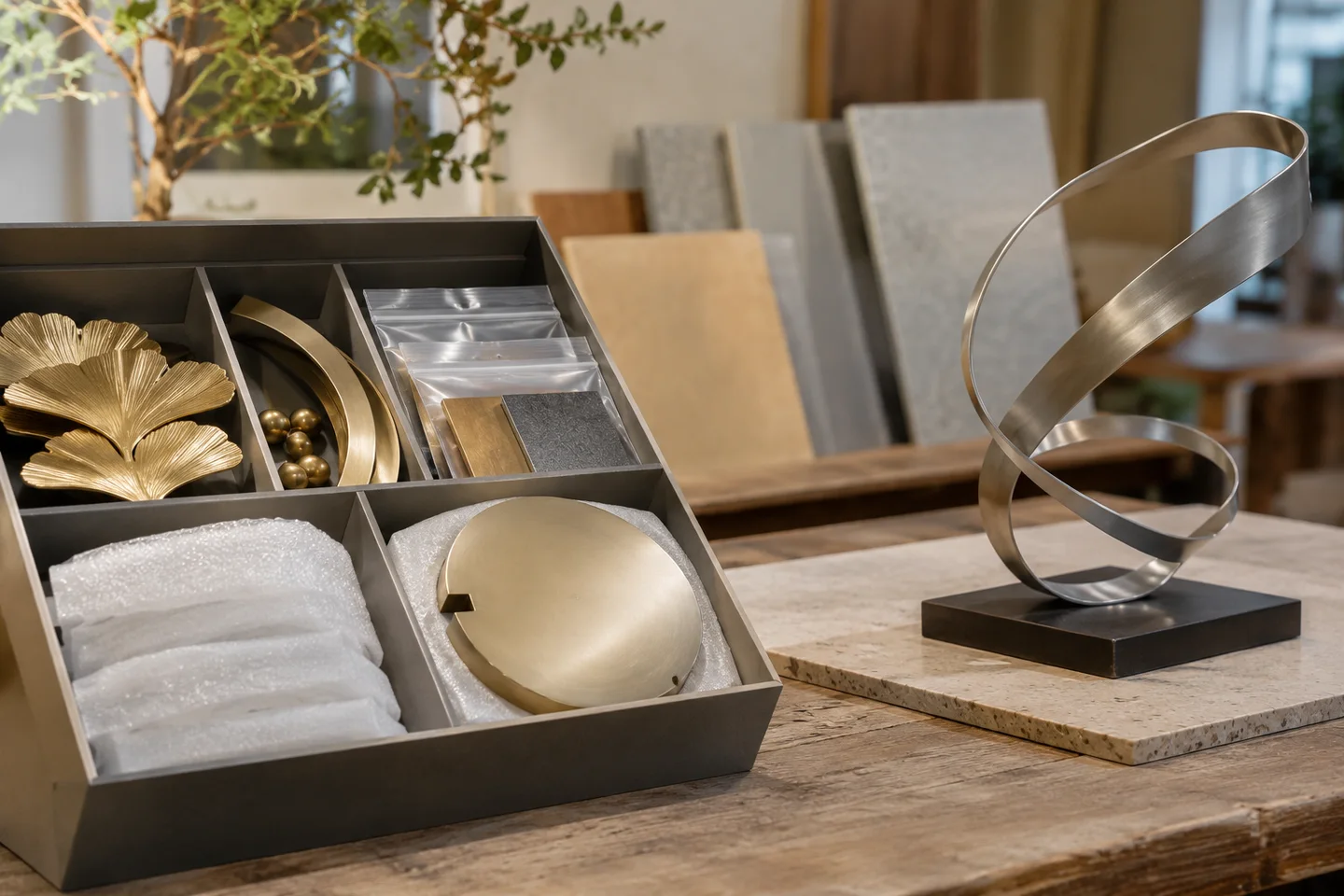
Facilities staff also need to know where the spare lives. Name the storage custodian and connect the box label to the asset index. An inventory with no physical location is difficult to use during a later incident. Open the custom decorative metal artwork references alongside the schedule when discussing removable elements, while keeping each project's confirmed scope distinct from the catalogue image.
Use acceptance gates to keep receipt separate from completion
Create four document states: requested, received, reviewed and accepted with exceptions or accepted. A file upload only completes the received state. Review should check that the file opens, identifies the correct asset and revision, and answers the requested question. Acceptance belongs to the named buyer representative with the authority assigned by the project, not automatically to the person downloading attachments.
| Decision | Suggested owner to name | Evidence to retain | Open issue treatment |
|---|---|---|---|
| Artwork and location identity | Buyer project lead | Asset index and location schedule | Resolve ambiguous references |
| Finish appearance | Authorized design reviewer | Sample reference and dated decision | List accepted variation or hold point |
| Installed interfaces | Appointed installation reviewers | Records within agreed scope | Separate missing technical review |
| Care and spares | Facilities representative | Usable instructions and counted schedule | Assign follow-up owner and due date |
These roles are a buyer planning model, not a statement that Weiya performs every task. Agree the actual appointment and deliverables before ordering. Keep receipt, appearance acceptance, technical review and commercial closeout separate where their responsible parties differ. The flow diagram shows a release sequence that can be adapted to the contract without converting missing evidence into a presumed approval.
Make the digital pack usable after the project team leaves
Deliver an index in a commonly readable format and retain original editable files when their supply and usage rights are agreed. Include an offline copy of essential care information if facilities staff cannot rely on a supplier link staying available. Check access permissions with a person outside the project chat, and remove credentials or private contacts before distributing a wider reference copy.
Each change needs a revision note: what changed, why, who approved it and which previous document it supersedes. Updating a maintenance instruction should not erase the original finish acceptance record. If the artwork is moved, add a new location and condition entry while retaining the previous history. AMNH describes condition reports as a baseline updated after treatment; applying a similar history principle helps a facilities team avoid confusing later work with original delivery condition.
Run a short handover exercise. Ask the receiving team to find the approved finish, identify a spare, locate the care restrictions and name the person to contact about a new mark. Record any question they cannot answer. This checks practical usability without pretending that a folder inspection proves the sculpture's technical compliance.

Use the worksheet to request a comparable handover scope
The downloadable document register is an original buyer tool. Before issuing an RFQ, fill in asset ID, requested deliverable, proposed owner and acceptance criterion. After responses arrive, add inclusion status, file revision, evidence location, review decision and unresolved action. Duplicate rows for separate artworks or components; do not combine several unknowns into a single tick marked complete.
For example, one row can request an identified finish approval record and another can request instructions for that same surface. If a bidder supplies photographs but excludes a retained sample, record both facts. The comparison is about scope clarity, not automatically preferring the longest document list. Not-applicable items should carry a reason, while unresolved critical items remain visible to the decision maker.
This guide covers records for operation and handover, rather than repeating a shipment inspection checklist. Use the pre-shipment inspection guide for evidence before packing, then bring those records forward into the index. For a new commission, send the artwork reference, finish direction, destination, facilities requirements and requested spare categories through the project inquiry below. Ask for a proposal-specific response; document supply, replacement parts and future assistance must be agreed rather than assumed.
Download the handover document register
Download the editable CSV worksheet. Create a row for each deliverable or spare category. Record inclusion, ownership, file revision, review decision and unresolved action; an uploaded file is not automatically accepted.
Explore decorative metal sculpture project references and send the artwork reference and project requirements for a scoped inquiry.
FAQ
Is a catalogue photograph an adequate finish approval record?
It is an appearance reference, but it does not identify what was approved for a particular order. Record the accepted sample or other agreed reference, revision, reviewer, date and viewing conditions separately.
Does receiving the handover folder mean the sculpture is accepted?
No. Document receipt, review and acceptance should have separate statuses. The authorized reviewer needs to identify missing items and agreed exceptions under the actual project process.
Should every metal sculpture use the same care instructions?
No. Request instructions for the confirmed material, surface treatment and setting. Avoid applying a general polish or cleaning method to an unidentified finish without project-specific advice.
Are spare fittings automatically included or interchangeable?
No. Agree identifiers, compatibility, quantities, inclusion status and substitution restrictions. Appearance alone cannot establish that a replacement part is suitable, especially for safety-related components.
What should I send with a handover document request?
Send the artwork or catalogue reference, approved revisions if available, finish direction, destination, intended use, facilities requirements and a list of requested records and spares. Mark unresolved details rather than inventing specifications.